


Choosing a Webflow development company is now a board-level decision, not a line item you hand to procurement. Your website is where most of your pipeline forms an opinion before a salesperson ever says a word, and the platform underneath it decides how fast you can respond when the market shifts. This guide is written for the people who own that number: founders, CMOs, and product leaders deciding whether Webflow, and the partner who builds in it, can carry a digital product through real growth.
We build in Webflow every week, so this is not a platform brochure. It is what we have learned about where a Webflow build creates measurable lift, where it quietly leaks revenue, and how to tell a capable partner from an expensive one before you sign anything.
What a Webflow development company does end to end
A Webflow development company designs, builds, and maintains production websites on Webflow, turning brand and product goals into responsive pages, a structured content model, and clean front-end code that a marketing team can run day to day without an engineer on standby.
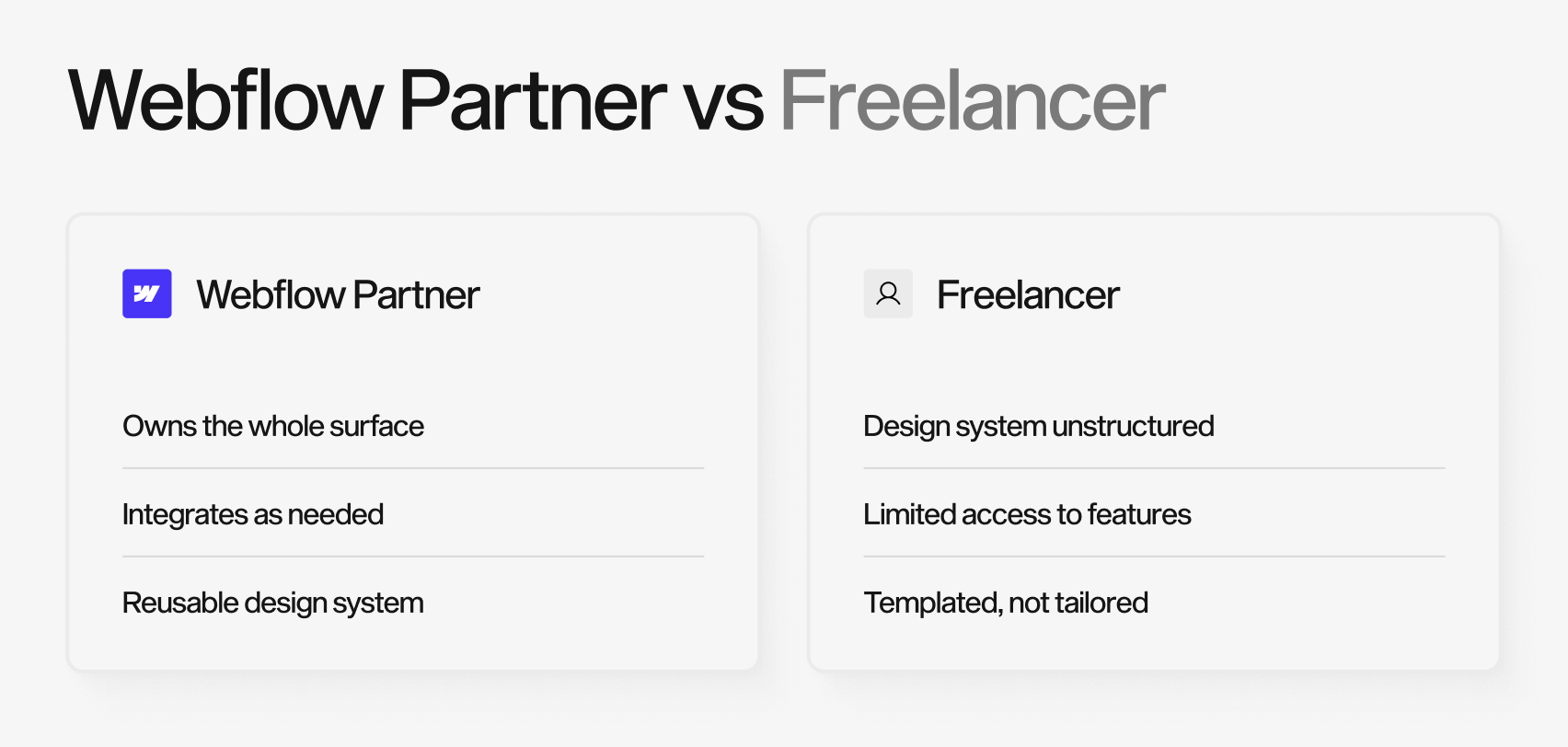
That last part is the difference between a real partner and a freelancer with a template. A serious Webflow development company owns the whole surface: information architecture, a reusable component system, CMS collections that scale past a launch-day content dump, integrations with your CRM and analytics, Core Web Vitals performance, accessibility, and a handoff that leaves your team able to ship changes themselves. The build is the visible part. The system you can operate afterwards is the part that pays you back.
Why a Webflow development company is the default now, not a luxury
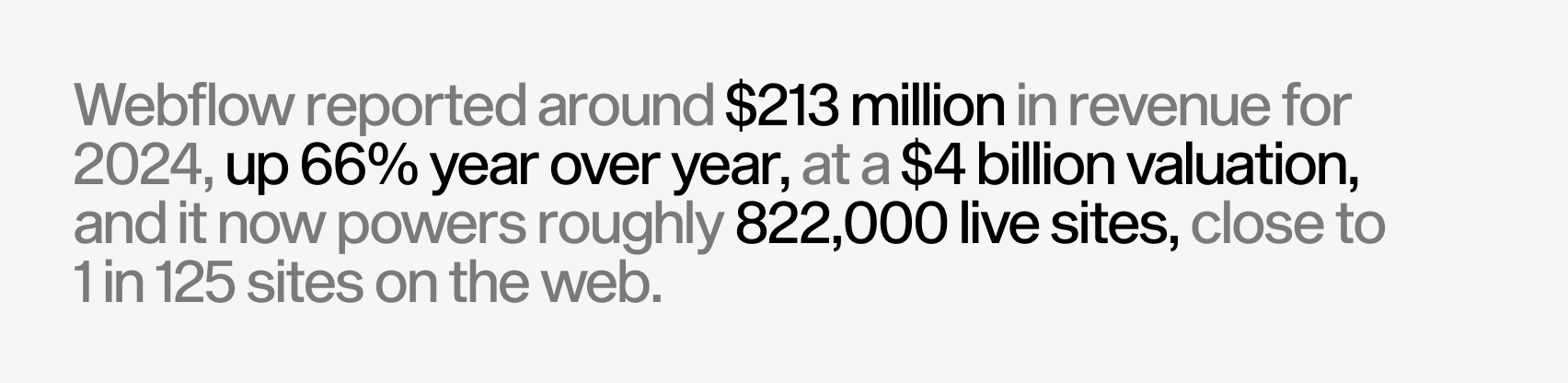
A decade ago, choosing Webflow signalled a small marketing site. That framing is out of date. Webflow reported around $213 million in revenue for 2024, up 66% year over year, at a $4 billion valuation, and it now powers roughly 822,000 live sites, close to 1 in 125 sites on the web. Its enterprise revenue grew eightfold in a single year early in that climb, and its share of the top 10,000 highest-traffic sites has been rising faster than its overall share. Larger companies are moving onto the platform, not away from it.
The wider shift matters more than any one platform. Gartner projects the low-code and no-code market near $44.5 billion in 2026, and forecasts that 70% of new enterprise applications will be built with low-code or no-code tools, up from under 25% in 2020. Visual development is where the industry is going, and there is a hard reason for it: the talent math. Front-end engineering time is scarce and expensive, and every hour a developer spends nudging a marketing page is an hour not spent on your core product. A Webflow development company lets you move that work off the engineering backlog, so designers ship layouts, interactions, and CMS changes directly and your engineers stay on the product that earns the revenue.
The adoption curve is steepest exactly where growth pressure is highest. B2B SaaS companies and venture-backed startups are moving to the platform fastest, because they compete on speed-to-market and on how sharply the brand tells its story, and both are things a visual platform lets a small team control directly. The outcome reported across these moves is unglamorous and valuable: pages ship faster, launches slip less often, and developer effort shifts from maintaining marketing pages to building the product itself.
For a C-level reader, that is the business case in one line: faster time-to-market on the highest-traffic asset you own, without borrowing against product velocity. The website stops being a quarterly bottleneck and starts behaving like a channel you can steer.
Best practices that move conversion and retention
Platform choice sets the ceiling. Execution decides whether you reach it. These are the patterns that separate a Webflow build that performs from one that only looks finished.
Treat performance as a revenue line, not a technical score
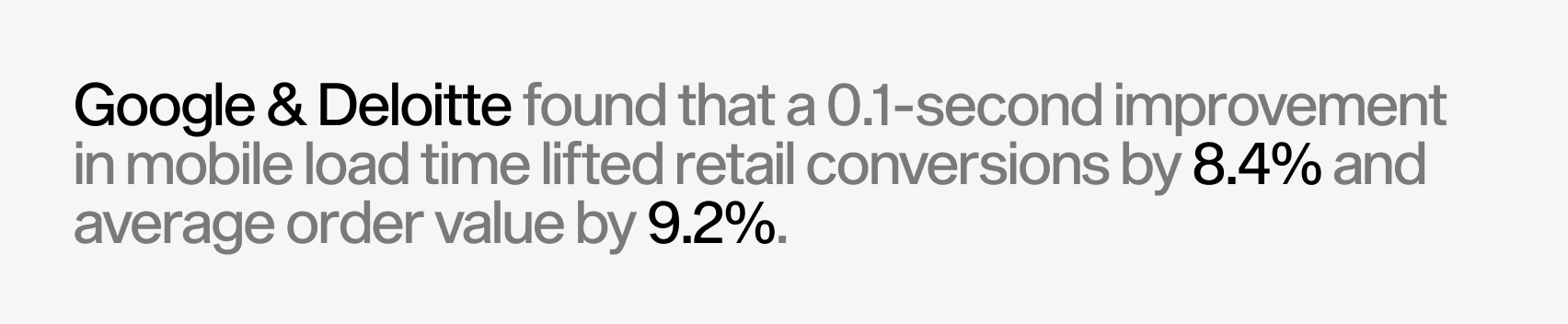
Speed is the most direct link between how a site is built and what it earns. Google and Deloitte's Milliseconds Make Millions study, run across 37 brands and roughly 30 million sessions, found that a 0.1-second improvement in mobile load time lifted retail conversions by 8.4% and average order value by 9.2%. Akamai's analysis of billions of retail visits tied a 100-millisecond delay to a 7% drop in conversions. Google research separately found that 53% of mobile visitors abandon a page that takes longer than three seconds to load.
Webflow generates clean production code, which gives you a head start, but it does not make performance automatic. Heavy media, unmanaged third-party scripts, and animation piled on without a budget will drag Core Web Vitals down on any platform. A capable Webflow development company sets a performance budget at the start and defends it through the build, because a tenth of a second is a number you can read straight off your revenue.
Build on a design system, not a pile of pages
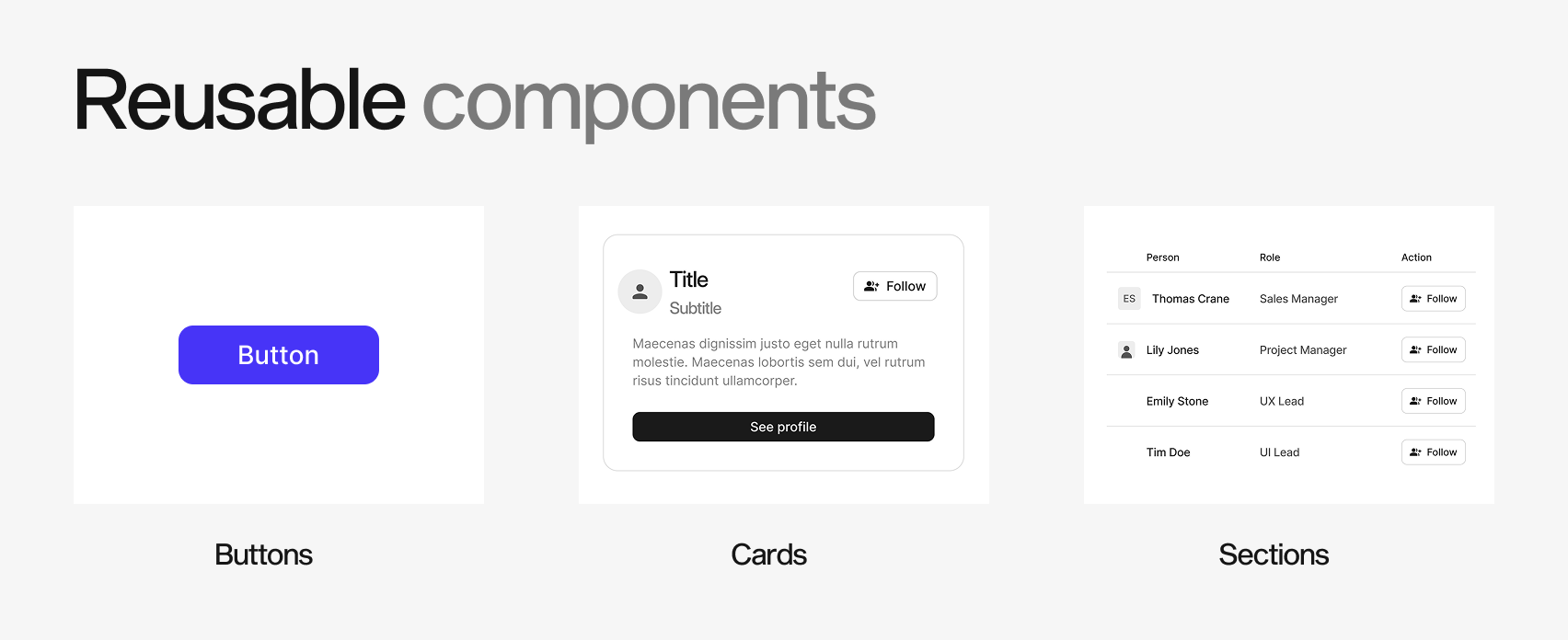
Componentization is the quiet driver of both consistency and speed. When buttons, cards, and sections are reusable components tied to shared styles, a brand refresh becomes one change instead of a hundred, and every new page inherits the same trust signals your best page already earns. This is where a design system approach pays off: it protects quality as the site grows and stops the slow visual drift that erodes credibility over time. It also lowers the cost of every future change, which is what keeps clients with a partner for years rather than months.
Make structure, SEO, and accessibility part of the build
Semantic markup, a logical heading hierarchy, and accessible components are not a compliance chore bolted on at the end. They are the same foundation that answer engines and screen readers both rely on. A cleanly structured build is easier for Google to crawl, easier for an AI overview to cite, and usable by more of your market. Getting this right is a core reason to hire a specialist rather than lean on a generic builder.
There is a commercial edge here too. Accessibility requirements are tightening across the US and EU, and an inaccessible site is both a legal exposure and a slice of the market you turn away at the door. Building to standard from the start costs far less than retrofitting a site that shipped without it.
Design the CMS for where the content is going
Most sites are architected for launch day and buckle under the weight of the twentieth landing page. Content collections, localization, and reusable templates should be modelled around a year of growth, not the first press release. Webflow's DevLink also connects visual design to production React, which means the line between your marketing site and your actual product is thinner than it used to be. A partner who understands both sides can build with that in mind.
Measure the site, or you are guessing
A site you cannot measure is a site you cannot improve. Before launch, a good partner wires up analytics, event tracking, and a clear definition of what counts as a conversion on each key page, so the team can see which changes help and which quietly hurt. This is the same instinct that separates a controlled rebuild from a two-year gamble: you want the numbers in place to catch a regression in week one, not in the quarterly report. It also sets up the next era of the platform, because personalization and testing are worth nothing without a baseline to test against.

Plan the handoff before you plan the homepage
The most overlooked practice is enablement. A build your team cannot edit becomes a dependency, and a dependency becomes churn. Strong responsive web design and a clean component library should leave you with documentation and a team that can publish a new page on Friday afternoon without filing a ticket. Ownership is the retention lever, for your users and for the relationship with your partner.

As a rule of thumb, the design community has long cited a rough return of up to $100 for every $1 invested in UX. Treat that as a directional signal rather than a hard measurement, but the direction is not in dispute: the work that happens before the first pixel is where conversion is won or lost.
The mistakes that cost conversion
The fastest way to understand what good looks like is to study what expensive failure looks like. Two public redesigns show the same lesson from different angles, and both scale down to a B2B site with a fraction of the traffic.
Snapchat: novelty is not improvement
In early 2018, Snapchat shipped a sweeping redesign that reorganized how Stories and messages appeared. The goal was to broaden the app's appeal. The result was a revolt. More than a million users signed a petition to reverse it, the change drew a now-famous public complaint from a high-profile user, and Snap reported its first-ever decline in daily active users, losing three million in a single quarter, which the CEO attributed directly to disruption from the redesign. The lesson for any digital product: users build habits around your current interface, and breaking a habit that works is a cost, not a feature. Change that ignores existing behavior does not read as fresh. It reads as broken.
Marks & Spencer: cosmetic thinking on a structural problem
The Marks & Spencer relaunch in 2014 is the cleanest cautionary tale in the field. The redesign reportedly cost around £150 million, won praise for its look, and then online sales fell about 8% in the quarter after launch, with a recovery that took roughly 18 months. The damage was structural, not visual: customers were forced to re-register on the new site, familiar labels were renamed in ways that confused people mid-purchase, and parts of the checkout path failed outright. The team treated a usability problem as a styling exercise, shipped two years of work in one revolutionary release, and had no incremental testing in place to catch the drop early or roll it back.
The pattern repeats at every scale. A growing SaaS company commissions a Webflow rebuild, the new site looks sharper, and conversion slips half a point because the pricing page buried its strongest proof and the mobile load time crept up. The redesign changed the surface without diagnosing the friction underneath. A disciplined Webflow development company treats a rebuild as a series of measured changes against a baseline, keeps the paths that already convert, and can roll back a regression before it shows up in the quarterly numbers. If your partner cannot tell you how they will measure whether the new site beats the old one, that is the warning sign.
How AI and automation are reshaping Webflow development
The role of a Webflow development company is shifting from building sites to operating them. Webflow is repositioning itself from a visual builder into what it calls a Website Experience Platform, and the clearest signal was its 2024 acquisition of Intellimize, an AI-driven personalization and conversion optimization tool. The intent is direct: let teams not only build a site but continuously personalize and test it for each visitor after launch. Webflow's own 2024 research found that 60% of marketing leaders felt their web stack was missing the mark, which is the gap this consolidation aims to close.
Generation is moving fast too. Webflow's AI Site Builder, launched in early 2025, passed 60,000 published sites within months, and DevLink continues to blur the line between a designed page and production React. Together, these tools compress the time from idea to live page and pull optimization into the platform itself. In practice, that looks like serving a different hero message to enterprise visitors than to self-serve ones, or running a structured test on a pricing layout and keeping the version that wins, without spinning up a separate engineering project each time.
Here is the part that matters for a decision-maker. AI raises the floor on how fast a site can be produced, which means the differentiator is no longer whether a partner can build it. The differentiator is judgment: whether they build it to perform, and whether they keep improving it once it is live. More output also means more ways to ship friction quickly, so governance, testing discipline, and a clear point of view become more valuable, not less. The Webflow development company worth hiring in 2026 treats your site as a growth asset it keeps tuning, using personalization and experimentation to move conversion and retention over time, rather than a one-time deliverable it hands over and forgets.
How to choose a Webflow development company
Evaluate partners against outcomes, not portfolios. A beautiful case study tells you a site looked good on launch day. It does not tell you whether that site still converts. Use these criteria.
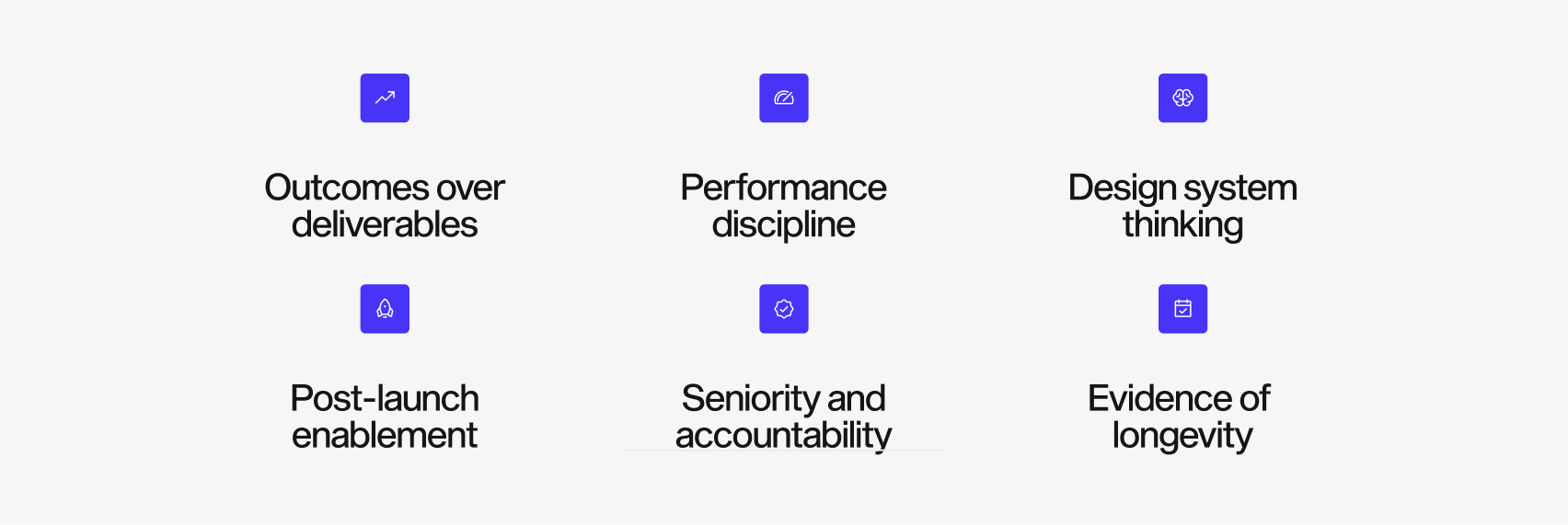
- Outcomes over deliverables. Ask how they define success and how they measure it. A partner who talks only about screens, and never about conversion, retention, or load time, is selling you a picture rather than a result.
- Performance discipline. They should raise Core Web Vitals and a performance budget before you do. This is a fast filter.
- Design system thinking. Reusable components and shared styles are the difference between a site that ages well and one you rebuild in two years.
- Post-launch enablement. You should leave the engagement able to run the site yourselves, with the option to keep them for optimization rather than the obligation.
- Seniority and accountability. Senior people who flag problems early and stand behind a recommendation are worth more than a large team that waits to be told what to do.
- Evidence of longevity. The work worth trusting is the work that is still running and still converting years after it shipped.
This is the standard we hold ourselves to. Over 80% of our clients are still working with us two years after the first project, which is the relationship a serious build is meant to create. We have designed and shipped web and product experiences for teams across fintech and connected hardware, from Accelpay to Kaiterra, and the through-line is the same: a product that looks good in a presentation but creates friction in real use is not a design success, it is a delayed failure. The work we are proudest of is the work still running, still converting, and still evolving years after we shipped it. If you want the commercial version of this decision, our Webflow development services page lays out scope and process, and for larger organizations our enterprise Webflow partner work covers the governance and scale questions in more depth.
Frequently asked questions
How much does a Webflow development company cost?
It depends on scope, and any firm quoting a flat number before understanding your site is guessing. A focused marketing site with a small CMS sits at the lower end. A large multi-language site with complex integrations, a full design system, and ongoing optimization sits well above it. The more useful question is what the site is worth to you: on a high-traffic page, the performance and conversion work often pays for the build several times over. Ask for a scope tied to outcomes, not a round number.
How long does a Webflow build take?
A straightforward site can launch in a few weeks. A larger build with research, a design system, custom interactions, and integrations typically runs a couple of months. The timeline is driven less by Webflow and more by decision speed on your side and how much is being designed from scratch versus adapted from an existing system.
Is Webflow a good choice for enterprise?
Increasingly, yes. Enterprise adoption is the fastest-growing part of Webflow's business, and its share of the highest-traffic sites keeps rising. The platform now supports the governance, localization, and performance requirements larger teams need. The real constraint at enterprise scale is rarely the tool. It is whether the partner can architect for that scale. This is the core of webflow website development done properly.
Webflow or WordPress?
WordPress still holds the largest CMS market share by a wide margin and remains a strong fit for content-heavy publishing. Webflow wins where design control, front-end quality, hosting, and speed of iteration matter most, and where a marketing team wants to run the site without engineering support for every change. For most product and B2B companies weighing brand experience against maintenance overhead, Webflow is the more efficient choice.
Is Webflow good for SEO?
Yes, when it is built properly. Webflow gives you clean semantic markup, full control over metadata and structure, and strong performance, all of which help. The platform does not do SEO for you. Strategy, content, and internal linking still decide whether you rank. A build that pairs technical cleanliness with a real content plan is what performs. Our work on fintech UX design and SaaS product design goes deeper on how design decisions and search performance connect.
The takeaway
A Webflow development company is worth hiring when it treats your site as a performing asset rather than a deliverable: fast, structured for growth, built on a system your team can run, and improved continuously after launch. The platform is proven and the trend is clear. The variable is the partner, and the pattern from every failed redesign is the same, a team that changed the surface without diagnosing the friction underneath.
If a new build or a rescue is on your roadmap, the next step is a conversation about outcomes, not screens. Book a UX/UI consultation, and we will tell you honestly where your site is leaking conversion and what it would take to fix it.



.png)