Choosing a product design agency is one of the higher-stakes calls a founder or product leader makes - one that doesn’t often come with a second chance within the same budget cycle. Make the right call, and you compress months of guesswork into a real product that actually ships and converts. Make the wrong call and pay twice: once for the build, second for the rebuild.
This guide is written for founders, product managers, and heads of design who are about to commit real money and time to a partner, and only want to spend once. It covers when to bring in a partner, what to evaluate, where budgets quietly leak, and a checklist you can run any shortlist through before you sign.
What a product design agency does, and how to choose one
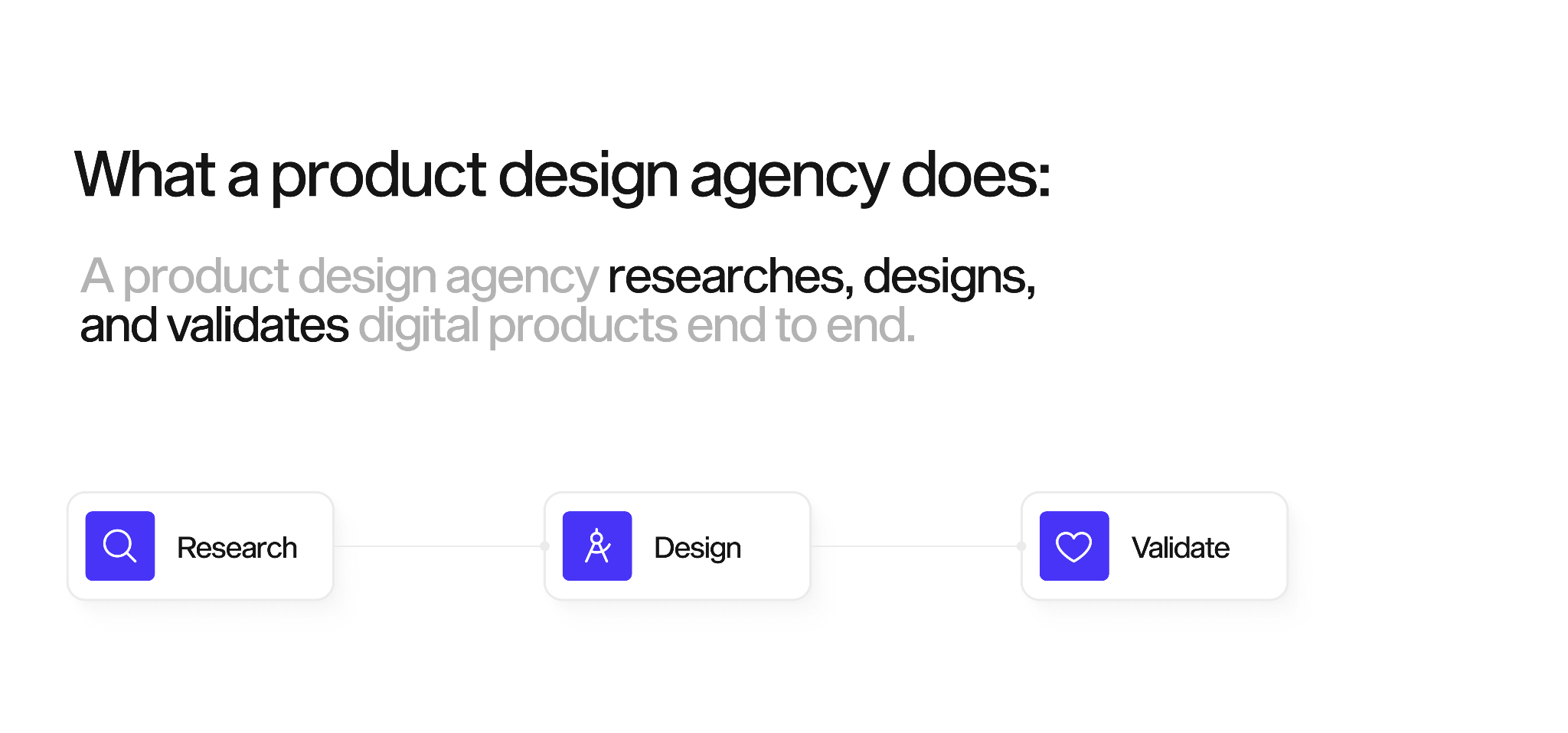
A product design agency is a team that researches, designs, and validates digital products end to end, from discovery, through UI, all the way to developer handoff. Choosing the best one means matching their shipped projects to your specific problem, interrogating their process, confirming senior people are on the job, and pressure-testing how well they communicate and respond to scope. A good fit and solid accountability beat a glossy portfolio every time.
Do you even need a product design agency?
Before you start comparing vendors, ask a more basic question: is outsourcing design the right move for you at all? The honest answer depends on your stage, your roadmap, and the problem in front of you. Hiring a partner for work you should be owning internally can burn a lot of money. Then again, building an internal team for a one-off project wastes more.
When an in-house team makes sense
Sometimes it can be best to keep design in-house when it’s a continuous, core function - rather than a project. If your product ships changes every week and is constantly evolving, your roadmap is dense for the next two years, and design decisions are tied to proprietary domain knowledge, an internal team pays for itself. In-house designers sit in standups, absorb context, and compound their understanding of your users over time.
The catch is hiring. A strong product designer is hard to find, slow to onboard, and expensive to replace. If you can’t attract senior talent or keep them busy with meaningful work, an internal hire becomes an underused fixed cost.

When a product design agency makes sense
Bring in a partner when you need senior firepower on a defined problem, faster than hiring allows. A new product, an MVP, a redesign of a stalled flow, or a module your team has no bandwidth for all fit this shape. A good agency has run these plays across dozens of builds, so they arrive with patterns rather than assumptions. A team that has designed onboarding for ten SaaS products already knows the traps in the eleventh, and that pattern library is most of what you’re paying for.
An outside team also gives you something an internal one can’t: distance. When a product is drifting and nobody inside can say why users are churning, a partner who wasn’t in the room for the original decisions can pinpoint the problem clearly. You also sidestep the cost of a bad senior hire, which in most markets runs well past a full year of salary once you count the ramp and the exit.
The case for a hybrid model
Most mature teams land somewhere in the middle. A product design agency leads discovery, sets the design system, and delivers the heavy first release. The in-house team then owns iteration, maintenance, and the day-to-day roadmap. This split gives you outside expertise on the parts that set direction and internal ownership on the parts that need continuity. If you go this route, agree early on how the handoff works and who owns the source files. The failure mode is an agency that builds a system only it can operate, leaving your team dependent long after the engagement should have ended. Insist that whatever gets built is documented to the point where your own designers can run it.
This is often the way to get the best of both worlds. On some of our projects in Widelab, we assign dedicated product designers to long-term client partnerships to support their in-house team. These designers are senior members of the team, integrated into the client’s projects fully, and working alongside them throughout the entirety of the product design and development cycle as part of the team. They have unique access to all agency resources, expertise, and support, as well as deep knowledge of the client’s internal workings.
What to look for when choosing a product design agency
Five key things separate a partner who ships a working product from a vendor who just sends you pretty slides. Weight them in this order.
Portfolio and proof, not a highlight reel
A portfolio full of concept art tells you an agency has a good eye and can draw. It doesn’t tell you they can ship, or think critically with business outcomes in mind. Look for products that launched and are still live, ideally in your problem space or one next to it. Then go one step further and ask what changed after launch: activation, retention, conversion, support load. If the answer is vague, treat the case study as decoration.
Verify what you can. A named client on a live URL is worth more than an anonymous chart with a suspiciously round percentage. Any agency worth hiring can point you to real work and, often, a reference call. At Widelab, over 80% of our clients stay with us for more than 2 years, long after the first product has shipped.
A process you can see in practice
Ask a potential partner to walk you through their process step by step: discovery, strategy, prototyping, design, testing, handoff. The words are easy to recite, so probe the seams.
- What happens when research contradicts the brief?
- How do they validate a direction before building it out?
- How do they decide what to cut when the timeline tightens?
A team with a real process answers without hesitation because they’re living it, day to day. A team improvising will describe an ideal or theoretically perfect scenario that never survives contact with a deadline. Ask to see the working files from a past project, not the polished case study, and you’ll learn more in five minutes than a pitch deck tells you in an hour.
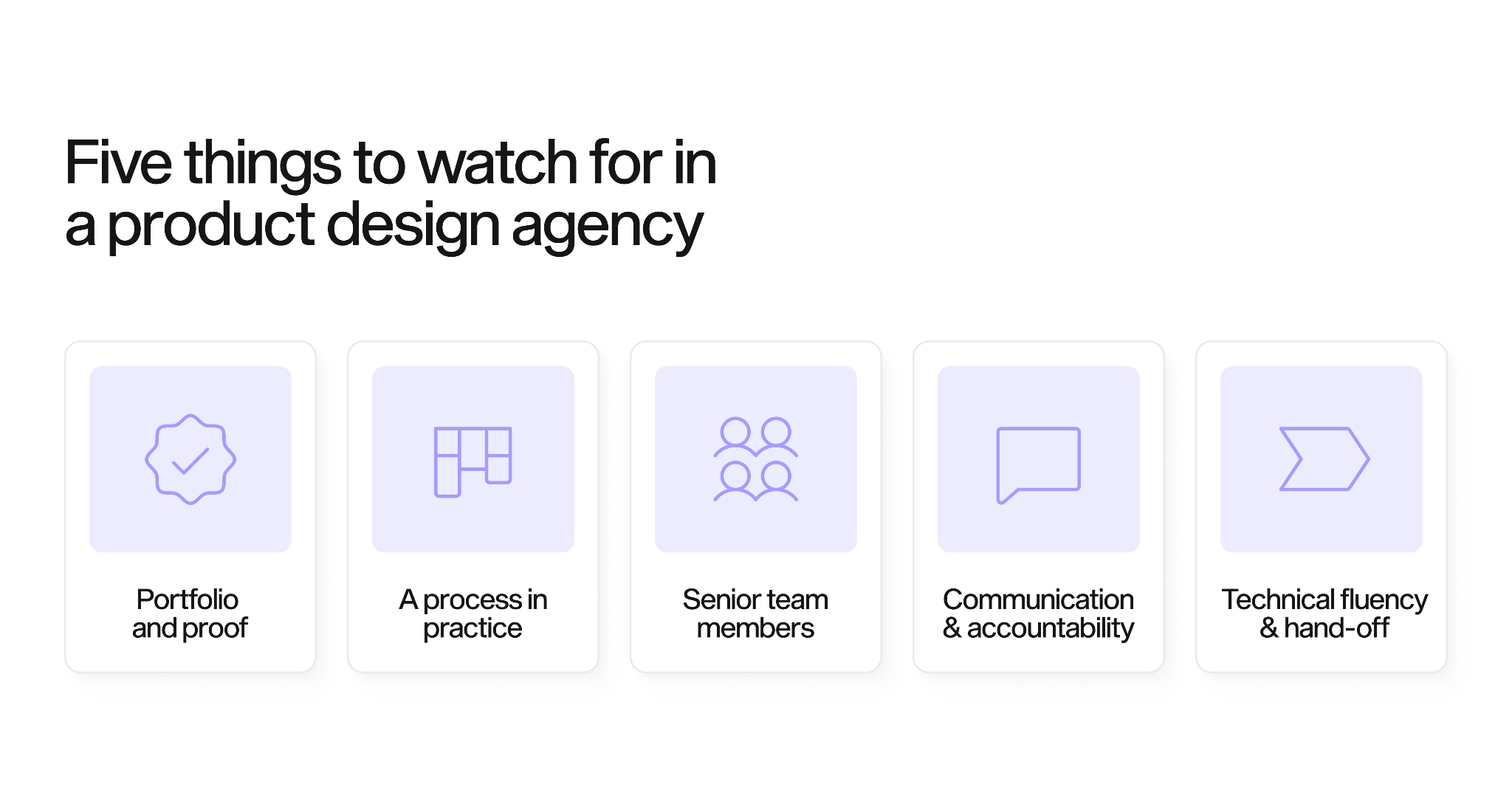
Senior people on your actual account
The oldest trick in agency sales is the seniority swap: partners and principals run the pitch, then juniors run the delivery. Ask directly who will be on your project day to day, how much of their time you get, and how much of the pitch team stays involved. You’re paying for judgment, and judgment comes from people who have shipped the mistake before and know how to avoid it. Widelab is made up of more than 60% senior team members with years of experience, and there’s never a sole junior dedicated to any project without expert oversight.
Communication and accountability
The best partners are honest. They flag problems before they become expensive, push back when the brief won’t work, and take responsibility for outcomes rather than deliverables. Watch how they handle disagreement in the sales process - if they agree with everything you say now, they’ll probably agree with everything when it matters less and costs more. You want the studio that tells you the uncomfortable truth early on, while it’s still cheap to fix. The best designers treat your product like their own reputation depends on it - because to them, it does.
Technical fluency and handoff
Design that can’t be built is a liability dressed as an asset. A serious studio works in design systems, ships developer-ready files, and knows how to collaborate with engineers so the handoff doesn’t become a second design phase. Ask how they hand off, what documentation engineers receive, and how they stay involved through build. This is where "beautiful but unbuildable" quietly dies.
Hidden costs and risks that burn budgets
The number on the invoice is the smallest figure in the equation. The big costs are the ones that never appear on the quote, and they’re where most product budgets get burned. A partner who costs more up front but removes these risks is often the cheaper choice once the full picture visible.
The cheap-quote trap
A low price for "screens only" feels like a saving until the bill arrives somewhere else. Cheap design defers cost to development, where engineers spend weeks asking questions the design should have answered, and to support, where a confusing flow generates tickets every day. The cost of underpriced design doesn’t show up on the design invoice. It shows up on the development invoice, the support queue, and the churn report. By the time it surfaces, the saving that justified the cheap quote is long gone, and the redesign you are now paying for costs more than doing it once would have.
Additionally, with the AI tools available to designers these days, producing quick prototypes and screens of a decent quality has never been as quick or as cost-effective.
Rework and the cost of fixing things late
There’s a long-standing rule of thumb in software: a problem caught in design costs one unit to fix, ten units in development, and a hundred units after release. The exact multiplier we can debate, but the direction of compounding we shouldn’t. Catching a flawed flow on a wireframe is cheap. Catching it after engineers have built it, users have hit it, and the roadmap has moved on is not. Correcting usability problems during the design phase has been shown to cut the cost of those fixes dramatically compared with fixing them post-launch.
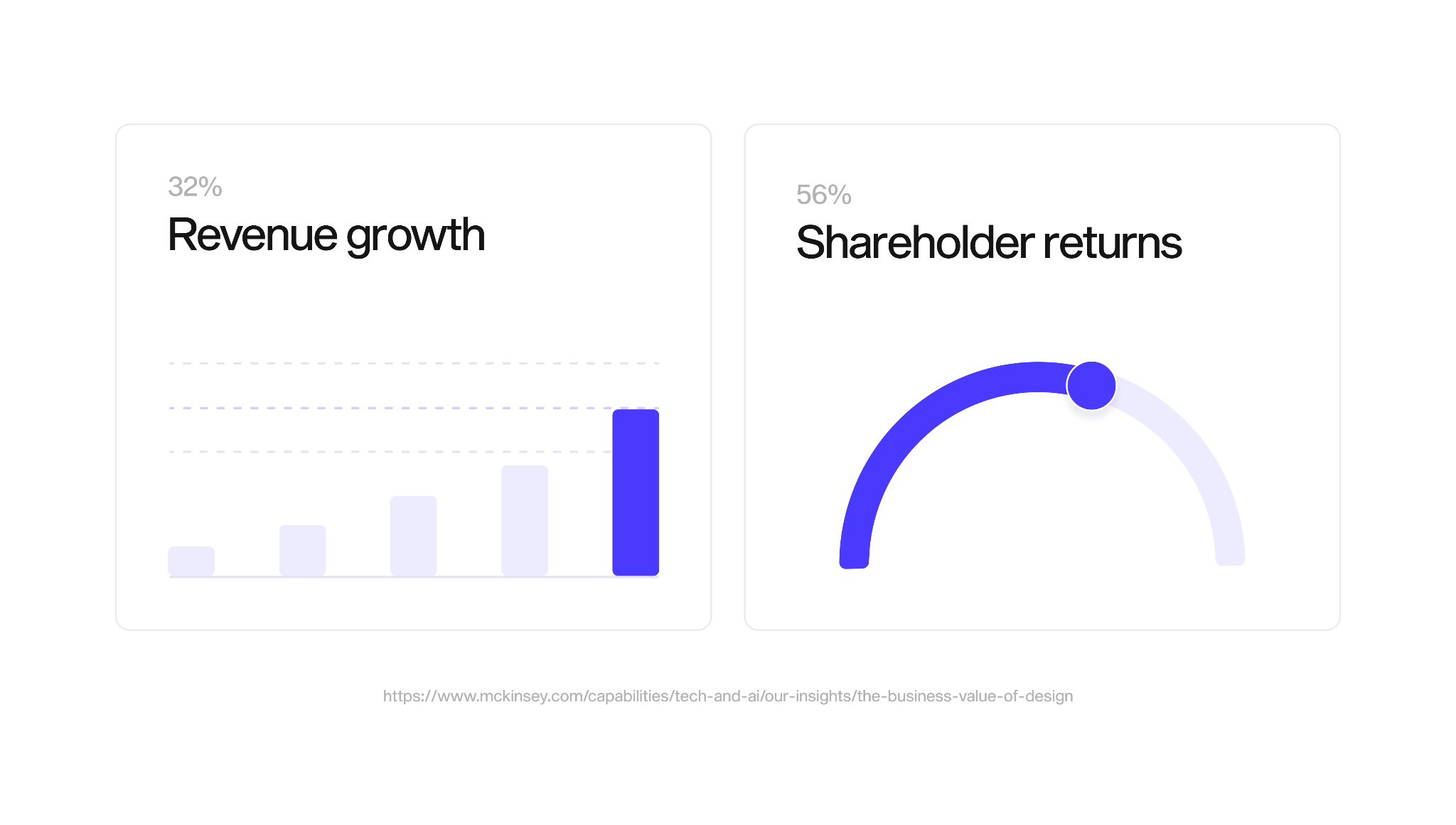
This is also why design quality shows up in the numbers over time. McKinsey's research on the business value of design found that companies in the top quartile for design grew revenue 32 percentage points faster than their industry peers over five years, and delivered 56 percentage points higher returns to shareholders. Design done well is not a cost. It’s a compounding advantage, making the wrong partner as expensive as they can be.
Key-person and continuity risk
Some agencies rest on one exceptional designer. When that person leaves, quality falls off a cliff and nobody left on the account can explain the decisions in the file. Ask how work is documented, whether the design system is maintained as a shared asset, and what happens to your project if a lead moves on. Business continuity is a feature, not an afterthought. A studio that treats documentation as overhead is fine right up until the day it is not, and that day tends to arrive at the worst possible point in your roadmap.
Vague scope and scope creep
Ambiguous scope is where relationships sour and budgets balloon. Before you sign, pin down what "done" means for each phase, how revisions are counted, and whether you’re on a fixed price or time and materials. A partner who scopes tightly and says no to unbounded requests is most likely protecting your budget, not limiting it. The inverse is the studio that says yes to everything in the sales call, then bills every change order at a premium once you’re committed. Clarity up front is worth more than flexibility that arrives with a payment request attached.
The 2026 product design agency evaluation checklist
Run every shortlisted studio through this before you commit. If a candidate fails more than two or three of these, keep looking.
- Shipped, live products in your space or an adjacent one, not concepts alone
- Post-launch outcomes they can describe: activation, retention, conversion, support load
- A named, verifiable client you could reference-check
- A process they can walk through end to end without improvising
- A clear answer for what they do when research contradicts the brief
- Senior people confirmed on your account, in writing, not only in the pitch
- A named point of contact and a defined cadence for updates
- Evidence they push back, flag risks early, and own outcomes
- Design-system and handoff practice that engineers can build from
- Documentation and continuity that survive one person leaving
- Scope defined in writing: phases, revisions, what "done" means, pricing model
- Cultural fit on how they communicate and make decisions under pressure
- A commercial model that ties their incentives to your product working, not only to hours billed

Print it, put it in your task tracker, whatever works. Score each agency against every line, and treat the gaps as questions to raise before the contract, not surprises to discover after it. The candidate that clears the most is rarely the cheapest and seldom the flashiest, and that’s usually the point.
Product design agency FAQ
How much does a product design agency cost?
Cost depends on scope, seniority, and duration far more than on any list price. A focused project such as an MVP or a single-flow redesign sits at the lower end, while a full end-to-end build with research, a design system, and ongoing iteration costs considerably more. Judge a quote by what it includes. A number with no research, testing, or handoff is not cheaper, it is smaller, and the difference lands on you later. The most useful question to ask isn’t "what does it cost" but "what does this price include, and what happens to the work I am not paying for here." That’s where the real comparison lives.
Product design agency vs freelancer vs in-house: which is right?
A freelancer suits a small, well-defined task where you already know the answer and need hands. An in-house team suits continuous, core design work with a dense roadmap. An agency suits defined, high-stakes projects where you need senior range across research, UI, and systems faster than you could hire it. Many teams combine an agency for the heavy first build with an in-house hire for maintenance.
How long does a product design project take?
A typical end-to-end project runs from a few weeks for a tightly scoped MVP to several months for a full product with research, design, testing, and a design system. The honest answer is that the timeline follows scope and decision speed. Agencies that quote a fixed date before understanding your problem are guessing, and you will pay for the guess. A better sign is a partner who scopes a short discovery phase first, then commits to a timeline once they know what they are building. Speed that skips discovery is the kind that produces rework.
What are the red flags when choosing a design agency?
The clearest warning signs: a portfolio of concepts with no shipped products, seniors in the pitch who vanish at delivery, a process they cannot describe without hedging, agreement with everything you say, and a quote that omits research, testing, or handoff. Any one is a caution. Two or more is a reason to walk.
Choosing a partner you won’t need to replace
The best outcome isn’t the agency you hire once. It’s the partner you stop thinking of as an agency, because they think about your product like it’s their own. That’s the difference between a vendor who delivers files and a studio that owns the outcome with you, flags the expensive problem before it lands, and builds something still running and still converting years later.
At Widelab, that’s the relationship we build for, and it’s why more than 80% of our clients are still working with us two years after the first project. We’ve shipped products across fintech, air-quality monitoring, developer tooling, and fuel-payment platforms for teams like Accelpay, Kaiterra, Ryve, and Circle-K, with senior designers on every account and real accountability for what we deliver. If you are weighing your options, the next step is simple.
Book a consultation with our team and bring your hardest product problem. We’ve likely solved a version of it before.

.png)