Warning ⚠️: No AI has been used in the process of writing this article. This human-generated output may lack the cliché sentence constructions and em dashes.
What even is AI?
I’ll be totally honest - I didn’t really jump on the hype train when AI started knocking on our door. Instead, what I found were some token-hungry assistants that took hours to properly prompt, giving back little more than limit warnings and slop.
But then, AI simply kicked those doors down. I would wake up in the middle of the night, anxious about staying behind my driven, relevant colleagues, and overthinking my future as a product designer. But as corny as it may sound, I’m really lucky to be part of this design studio, where I’m surrounded by inspiring designers, and knowledge spills out of every Slack channel.
Not being on my own, and having a community, helped me a lot in overcoming that anxiety, understanding this new reality, and its ever-changing tools.
mind=blown.
After over a decade of working in product design, a lot of my Figma work feels almost subconscious now. Having that much experience, jumping automatically into my „signature” patterns and best practices was almost immediate. On top of that, I’ve begun to witness the rise of „mathematizing” the product design work in the last couple of years.
After our most recent „tool earthquake” around 2019 (turning from Sketch to Figma), the „back-end” of our work kept growing endlessly with components, variants, tokens, variables, and processes. With my IC drive and hands-on approach, I felt like my actual skill needed to take a back seat in many cases. Projects took longer and longer to kick off, document, and hand off. I’ve often found myself jumping into other areas of design in my free time, just to feel that „spark” of simply creating.
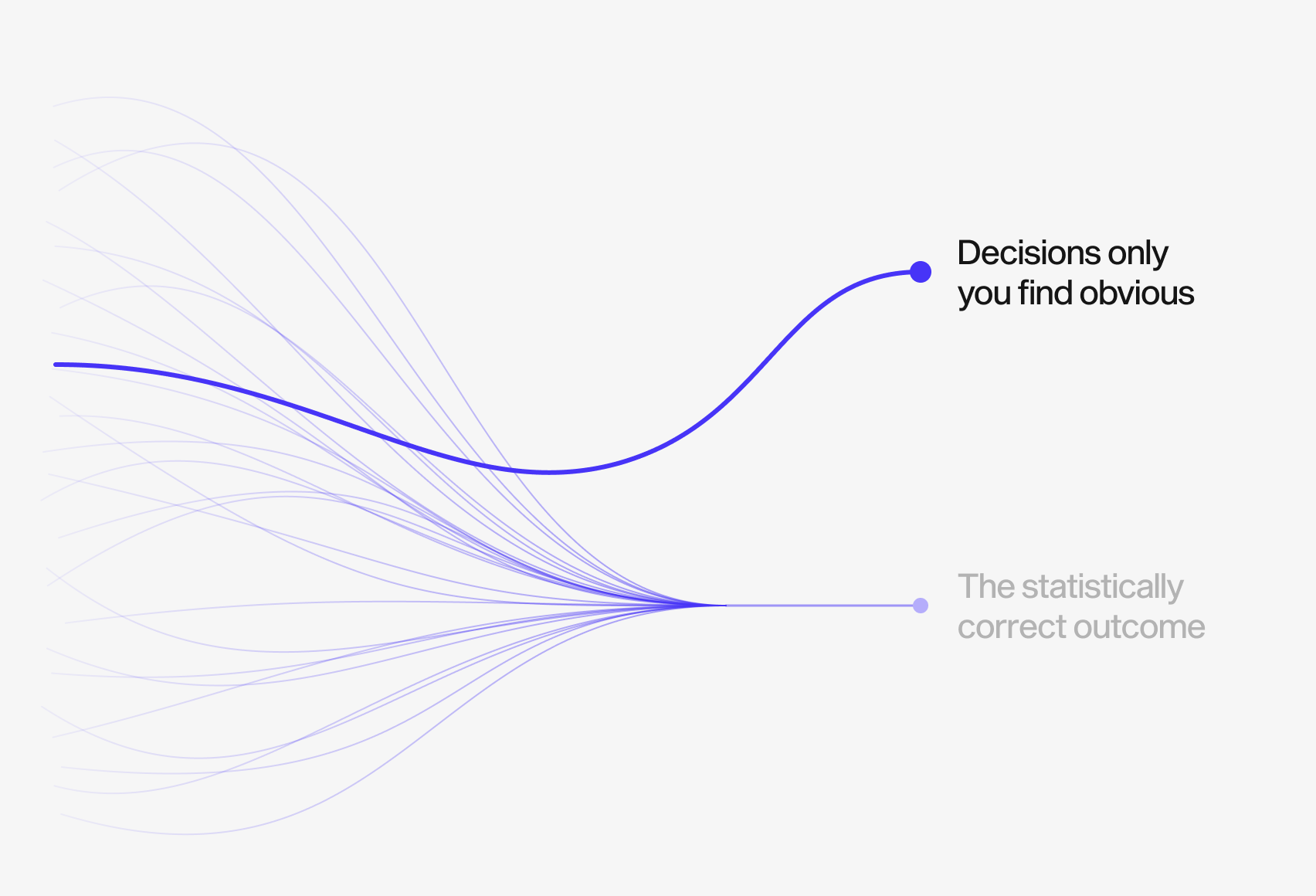
Nowadays, working directly in code enables me to think beyond the pixels. Iterating on the live prototype and not limiting myself to a single, flat screen opened my mind and brought me to better decisions about the product, flows, and interactions. Having to translate my thoughts into prompts led me to discover how vast my knowledge is and how many decisions that I’ve made throughout my past projects were just obvious to me - but not obvious to the AI model, which defaults to the most generic „statistically correct” outcome.
Of course, this results in a greater mental load, as we’re all figuring out how this works, what’s possible, and what our role actually is at this point, often navigating multiple areas beyond our core skill. This aspect should definitely be taken into account and monitored, both internally and within our organizations, so that the most driven people don’t end up simply burned out.
Flick of the switch
I’ve learned to embrace working alongside the agent after realizing that my craft and design sense are now at the forefront. My whole workflow is now stripped into one thing: thought. And I started to treat this moment as yet another tool switch. Because that’s what it essentially is - not a script for another Terminator movie. It feels overwhelming at first, as you lose control over instantly pushing that rectangle 1px down (perfectionist’s hell).
But to me, reimagining the whole mindset and process around design felt just as refreshing as opening my first canvas-based tool and experiencing its freedom (crazy how smooth Photoshop felt back then, right?).
What started as an „intern designer” is now a „quick-learning mid”, who understands my mental shortcuts and allows me to ship faster, bringing out the best in me after years in the field. If you’ve developed this twisted love towards interfaces (just like me), the tool itself is irrelevant. And vibe-coding could bring you closer to these feelings - maybe even reigniting what’s recently felt like a chore?